
Silence can express peace, tension, mystery, sadness, respect, or deep thought without saying a single word. The right similes for silent moments help readers visualize and feel that quietness more clearly.
In this guide, you’ll discover creative comparisons for describing people, places, emotions, conversations, and peaceful scenes. Each example is designed to make your writing more vivid while keeping the language natural, clear, and easy to understand.
Definition of Similes for Silence
Similes for silence are creative comparisons that describe silence by connecting it to another person, object, place, sound, or experience using words such as like or as.
For example, “The room was as silent as an abandoned library” compares the room’s lack of sound with the quietness associated with an empty library.
A strong simile does more than tell readers that something is quiet. It helps them imagine what that silence feels, looks, or sounds like. Similes commonly use explicit comparison words such as “like” and “as,” which distinguishes them from metaphors. (Literary Devices)
What Is a Simile?
A simile is a figure of speech that directly compares two different things by using words such as like, as, or similar comparison terms. Writers use similes to make descriptions more visual, emotional, memorable, and specific. (Literary Devices)
Example
- The classroom was as silent as a sleeping forest.
- Her voice disappeared like a candle flame in the wind.
- The hallway stood as quiet as an empty theater.
- His response was like a whisper beneath heavy rain.
A good simile highlights a shared quality. For silence, that quality might involve stillness, softness, emptiness, secrecy, calmness, tension, or the absence of sound.
Why Use Similes for Silence in Writing?
- Create vivid imagery: A comparison helps readers picture the silence instead of simply reading the word “silent.”
- Show emotion: Silence can suggest sadness, fear, peace, loneliness, anger, or concentration.
- Build atmosphere: A quiet setting can feel peaceful, mysterious, eerie, or tense depending on the comparison.
- Make descriptions memorable: Original comparisons give ordinary sentences more personality.
- Strengthen storytelling: A carefully chosen simile can help readers experience a scene instead of merely observing it.
- Add poetic quality: Figurative comparisons can make prose, poetry, speeches, and creative writing more expressive.
- Clarify abstract feelings: Emotional silence can feel difficult to explain literally, while a comparison can make it easier to understand.
- Avoid repetitive wording: Instead of repeatedly writing “the room was silent,” you can describe the silence in fresh ways.
Figurative language can strengthen imagery and emotional impact, but writers should use it purposefully rather than filling every sentence with comparisons. (Literary Devices)
Types of Similes for Silence
Silence does not always feel the same. Sometimes it feels peaceful; sometimes it feels frightening, lonely, mysterious, or thoughtful. Grouping similes by purpose makes it easier to choose the right comparison.
Descriptive Similes
Descriptive similes focus on how silence appears or feels in a particular setting. They work especially well in stories, essays, and descriptive paragraphs.
Example
- The library was as silent as a snow-covered village.
- The hallway was like a road before sunrise, empty and still.
- The room felt as quiet as a closed museum.
Emotional Similes
Emotional similes connect silence with feelings such as sadness, loneliness, fear, relief, or disappointment.
Example
- Her silence was like a locked door between two friends.
- His quietness felt as heavy as an unanswered question.
- The silence settled over him like a forgotten memory.
Peaceful Similes
Peaceful similes describe silence as gentle, relaxing, natural, or comforting.
Example
- The garden was as quiet as a sleeping meadow.
- The morning felt like a soft blanket without a sound.
- The lake rested as silently as a sleeping child.
Mysterious and Tense Similes
These comparisons make silence feel strange, suspenseful, threatening, or uncertain. They work well in mystery and dramatic writing.
Example
- The hallway was as silent as a secret waiting to be revealed.
- The forest stood like a witness refusing to speak.
- The room became as quiet as the moment before thunder.
Writing Tips and Common Mistakes
Useful Tips
- Choose a comparison that shares a clear quality with silence.
- Match the simile to the mood of your sentence.
- Use fresh comparisons instead of relying on familiar clichés.
- Keep the comparison easy enough for readers to understand.
- Consider sensory details such as darkness, stillness, distance, texture, or atmosphere.
- Avoid adding unnecessary words around a strong comparison.
- Read the sentence aloud to check whether the simile sounds natural.
- Use silence to reveal character or emotion when possible.
- Mix peaceful and dramatic comparisons to avoid repetitive descriptions.
- Prefer a precise simile over several weak ones.
Strong similes usually create a meaningful connection rather than simply adding decorative language. Writers can make comparisons more effective by choosing vivid details and avoiding overuse. (Literary Devices)
Common Mistakes to Avoid
- Using clichés too often: “As quiet as a mouse” can sound predictable.
- Choosing an unrelated comparison: The connection should make sense to the reader.
- Overexplaining the simile: Let the comparison do some of the descriptive work.
- Mixing conflicting images: Avoid combining unrelated comparisons in one sentence.
- Using too many similes: Several comparisons in every sentence can make writing feel crowded.
- Ignoring the mood: A frightening scene may not suit a cheerful comparison.
- Confusing similes with metaphors: “The room was like a tomb” is a simile, while “The room was a tomb” is a metaphor.
- Forcing the word “silent”: Let the comparison naturally communicate the absence of sound.
- Making the comparison too complicated: A clear image often works better than an elaborate one.
- Repeating the same structure: Vary “like” and “as” constructions when appropriate.
Similes For Silence
As Silent as a Snow-Covered Village
Meaning: Extremely quiet and peaceful, with almost no noticeable sound.
Detailed Explanation: This comparison connects silence with a village covered in fresh snow, where the snow seems to soften every movement and sound. It works well for peaceful settings.
Tone: Peaceful, serene, reflective
Examples:
- The village was as silent as a snow-covered village before sunrise.
- The street became as silent as a snow-covered village after midnight.
- The neighborhood felt as silent as a snow-covered village during the winter storm.
Like a Candle Flame Without a Flicker
Meaning: Completely still and quiet.
Detailed Explanation: A candle flame without movement suggests an unusual sense of stillness. This simile works well when describing a person who remains completely quiet.
Tone: Calm, poetic, gentle
Examples:
- She sat quietly like a candle flame without a flicker.
- His presence remained still like a candle flame without a flicker.
- The child watched the ceremony like a candle flame without a flicker.
As Quiet as an Empty Theater
Meaning: Almost completely silent and deserted.
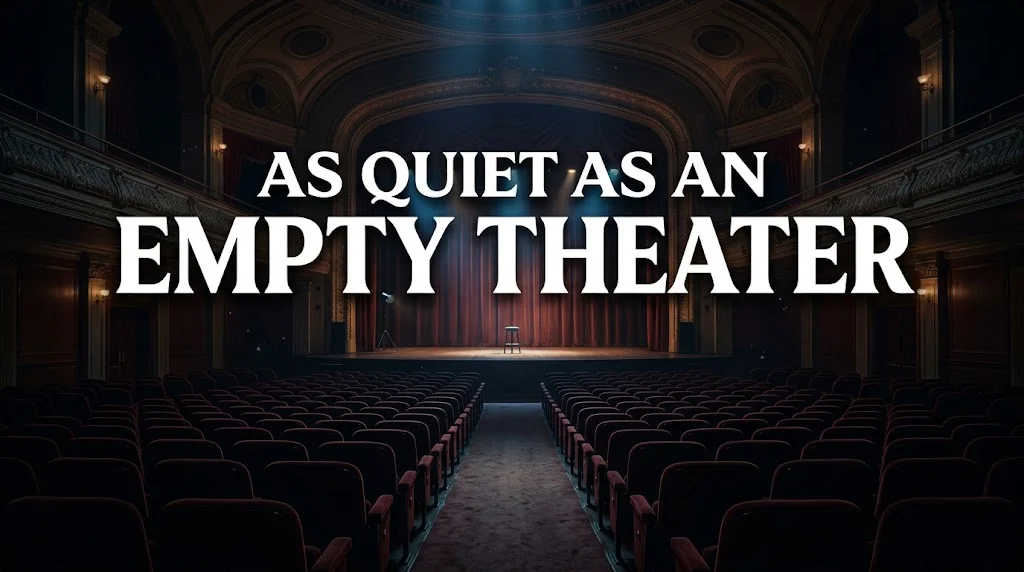
Detailed Explanation: An empty theater can feel surprisingly quiet because it normally carries voices, music, and applause. The comparison emphasizes the contrast between expected noise and complete silence.
Tone: Dramatic, atmospheric, calm
Examples:
- The hall was as quiet as an empty theater.
- The school became as quiet as an empty theater after everyone left.
- The auditorium stood as quiet as an empty theater before the show.
As Quiet as a Hidden Cave
Meaning: Deeply silent and isolated.
Detailed Explanation: A hidden cave creates an image of distance from ordinary noise. The comparison works for secluded locations or private thoughts.
Tone: Mysterious, isolated, peaceful
Examples:
- The valley was as quiet as a hidden cave.
- His room felt as quiet as a hidden cave.
- The forest path became as quiet as a hidden cave.
Like a Bell After Its Last Ring
Meaning: Silent after a sound or event has ended.
Detailed Explanation: A bell becomes quiet immediately after its final ring. This simile captures the transition from sound to silence.
Tone: Reflective, final, peaceful
Examples:
- The hall became silent like a bell after its last ring.
- Her voice faded like a bell after its last ring.
- The celebration ended like a bell after its last ring.
As Silent as a Closed Window
Meaning: Quiet and separated from the outside world.
Detailed Explanation: A closed window blocks outside sounds and creates a sense of separation. This makes it useful for describing private spaces.
Tone: Calm, isolated, restrained
Examples:
- The room was as silent as a closed window.
- Her office remained as silent as a closed window.
- The house felt as silent as a closed window.
Like Mist Settling Over a Field
Meaning: Silence that gradually spreads across a place.
Detailed Explanation: Mist slowly covers a field, creating a soft and quiet atmosphere. This comparison works well when silence arrives gradually.
Tone: Soft, mysterious, peaceful
Examples:
- Silence spread like mist settling over a field.
- The evening became quiet like mist settling over a field.
- The conversation faded like mist settling over a field.
As Quiet as a Sleeping Child
Meaning: Gentle, peaceful, and completely still.
Detailed Explanation: A sleeping child often creates a delicate image of calmness. This comparison works well for warm and peaceful settings.
Tone: Gentle, tender, peaceful
Examples:
- The house was as quiet as a sleeping child.
- The nursery remained as quiet as a sleeping child.
- The morning felt as quiet as a sleeping child.
Like a Room Holding Its Breath
Meaning: Tense silence filled with anticipation.
Detailed Explanation: A room cannot literally breathe, but the comparison gives the setting a human quality. It suggests that everyone is waiting for something to happen.
Tone: Suspenseful, dramatic, tense
Examples:
- The classroom became like a room holding its breath.
- The audience waited like a room holding its breath.
- The office felt like a room holding its breath.
As Silent as an Empty Beach at Dawn
Meaning: Peacefully quiet and free from human activity.
Detailed Explanation: An empty beach at dawn combines natural beauty with isolation. It creates a soft image of silence before the day becomes busy.
Tone: Peaceful, fresh, reflective
Examples:
- The coast was as silent as an empty beach at dawn.
- The morning was as silent as an empty beach at dawn.
- The village felt as silent as an empty beach at dawn.
Like Dust Floating in Sunlight
Meaning: Quiet, delicate, and barely noticeable.
Detailed Explanation: Dust floating through sunlight moves gently and creates little sound. This comparison gives silence a light and visual quality.
Tone: Delicate, poetic, nostalgic
Examples:
- The room felt like dust floating in sunlight.
- Her movements were like dust floating in sunlight.
- The afternoon passed like dust floating in sunlight.
As Quiet as a Garden Behind a Wall
Meaning: Peaceful and protected from outside noise.
Detailed Explanation: A wall can block sounds from busy surroundings. This comparison suggests a private space where silence remains protected.
Tone: Peaceful, private, sheltered
Examples:
- The courtyard was as quiet as a garden behind a wall.
- Their home felt as quiet as a garden behind a wall.
- The old library was as quiet as a garden behind a wall.
Like a Thought Kept Behind the Lips
Meaning: Something remains unspoken.
Detailed Explanation: The image suggests that a person has something to say but deliberately keeps the words inside. It works especially well for emotional restraint.
Tone: Emotional, restrained, intimate
Examples:
- Her confession remained like a thought kept behind the lips.
- His anger stayed like a thought kept behind the lips.
- The apology sounded like a thought kept behind the lips.
As Silent as a Road After Midnight
Meaning: Completely quiet because almost everyone has gone home.
Detailed Explanation: A road after midnight can become empty and still, making it an easy image for deep nighttime silence.
Tone: Lonely, calm, cinematic
Examples:
- The town was as silent as a road after midnight.
- The highway felt as silent as a road after midnight.
- The neighborhood became as silent as a road after midnight.
Like a Snowflake Resting on Glass
Meaning: Extremely delicate and quiet.
Detailed Explanation: A snowflake resting on glass suggests softness, stillness, and fragility. It suits gentle scenes rather than tense ones.
Tone: Delicate, peaceful, poetic
Examples:
- Her footsteps were like a snowflake resting on glass.
- The morning felt like a snowflake resting on glass.
- His voice disappeared like a snowflake resting on glass.
As Quiet as a Hidden Nest
Meaning: Protected, private, and peacefully silent.
Detailed Explanation: A hidden nest suggests safety and seclusion. This comparison works well when silence feels comforting rather than lonely.
Tone: Warm, peaceful, sheltered
Examples:
- The cottage was as quiet as a hidden nest.
- The bedroom felt as quiet as a hidden nest.
- The garden corner remained as quiet as a hidden nest.
Like a Photograph Waiting for Time
Meaning: Frozen, still, and untouched by immediate activity.
Detailed Explanation: A photograph preserves a moment, while the idea of waiting gives the silence a sense of suspended time.
Tone: Reflective, nostalgic, poetic
Examples:
- The old street looked like a photograph waiting for time.
- The room felt like a photograph waiting for time.
- The abandoned house stood like a photograph waiting for time.
As Silent as a Library Before Opening
Meaning: Completely quiet before people arrive.
Detailed Explanation: A library before opening hours provides a realistic image of a place prepared for activity but currently untouched by voices.
Tone: Calm, orderly, peaceful
Examples:
- The building was as silent as a library before opening.
- The classroom felt as silent as a library before opening.
- The office remained as silent as a library before opening.
Like a Song After the Music Stops
Meaning: Silence that follows an emotional or meaningful moment.
Detailed Explanation: The end of a song can leave a powerful silence behind. This comparison works especially well when describing endings.
Tone: Emotional, reflective, bittersweet
Examples:
- The farewell felt like a song after the music stops.
- Her voice faded like a song after the music stops.
- The celebration ended like a song after the music stops.
As Quiet as a Lantern in an Empty Lane
Meaning: Softly peaceful and isolated.
Detailed Explanation: A lantern in an empty lane creates a quiet nighttime image with a small point of light surrounded by stillness.
Tone: Poetic, peaceful, lonely
Examples:
- The village was as quiet as a lantern in an empty lane.
- The street felt as quiet as a lantern in an empty lane.
- The evening became as quiet as a lantern in an empty lane.
Like a Memory No One Mentions
Meaning: Quiet because everyone avoids discussing something.
Detailed Explanation: A shared memory can remain powerful even when nobody speaks about it. This simile gives silence an emotional and social dimension.
Tone: Sad, reflective, serious
Examples:
- The room felt like a memory no one mentions.
- Their silence was like a memory no one mentions.
- The subject remained like a memory no one mentions.
As Silent as a Doorway Before Footsteps
Meaning: Quiet while waiting for something to happen.
Detailed Explanation: A doorway before footsteps suggests anticipation. It works well in suspenseful scenes where silence signals an approaching event.
Tone: Suspenseful, expectant, dramatic
Examples:
- The hallway was as silent as a doorway before footsteps.
- The house remained as silent as a doorway before footsteps.
- The corridor felt as silent as a doorway before footsteps.
Like a Feather Resting on Still Water
Meaning: Extremely gentle, delicate, and quiet.
Detailed Explanation: Both the feather and still water suggest softness and a lack of disturbance. The combined image creates peaceful silence.
Tone: Gentle, elegant, serene
Examples:
- Her movement was like a feather resting on still water.
- The room settled like a feather resting on still water.
- The morning passed like a feather resting on still water.
As Quiet as a Secret Garden at Night
Meaning: Peacefully secluded and mysterious.
Detailed Explanation: A secret garden already suggests privacy, while nighttime adds another layer of quietness and mystery.
Tone: Mysterious, romantic, peaceful
Examples:
- The courtyard was as quiet as a secret garden at night.
- The path felt as quiet as a secret garden at night.
- The old estate stood as quiet as a secret garden at night.
Like a Question Left Hanging in the Air
Meaning: Silence caused by uncertainty or an unanswered issue.
Detailed Explanation: An unanswered question can create a pause that feels heavy and noticeable. This comparison works well in conversations and dramatic scenes.
Tone: Tense, thoughtful, uncertain
Examples:
- His silence was like a question left hanging in the air.
- The meeting ended like a question left hanging in the air.
- Her expression remained like a question left hanging in the air.
As Silent as a Mountain Under Moonlight
Meaning: Deeply quiet, vast, and majestic.
Detailed Explanation: A mountain beneath moonlight suggests enormous natural stillness. This simile works well for landscapes and powerful quiet moments.
Tone: Majestic, peaceful, dramatic
Examples:
- The valley was as silent as a mountain under moonlight.
- The countryside appeared as silent as a mountain under moonlight.
- The night felt as silent as a mountain under moonlight.
Like Words Trapped Behind a Wall
Meaning: Thoughts or feelings exist but cannot be expressed.
Detailed Explanation: A wall represents a barrier, making this comparison useful for emotional silence, hesitation, or communication problems.
Tone: Emotional, frustrated, serious
Examples:
- His feelings were like words trapped behind a wall.
- Her explanation remained like words trapped behind a wall.
- Their apology felt like words trapped behind a wall.
As Quiet as the Moment After a Storm
Meaning: Peaceful silence following noise or conflict.
Detailed Explanation: After a storm, the sudden return of calm can feel powerful. This simile works especially well when silence follows an argument or dramatic event.
Tone: Relieved, peaceful, reflective
Examples:
- The house was as quiet as the moment after a storm.
- The street became as quiet as the moment after a storm.
- Their conversation ended as quiet as the moment after a storm.
Top 10 Similes For Silent
| Simile | Meaning | Tone |
| As Silent as a Snow-Covered Village | Deeply quiet and peaceful | Serene |
| Like a Whisper Lost in Fog | Faint, delicate, and difficult to hear | Mysterious |
| As Quiet as an Empty Theater | Completely quiet and deserted | Dramatic |
| Like a Breath Held Too Long | Tense and emotionally restrained | Suspenseful |
| As Still as a Sleeping Lake | Calm and undisturbed | Peaceful |
| Like a Letter Never Sent | Unspoken thoughts or emotions | Emotional |
| As Silent as a Desert Before Dawn | Vast, empty, and deeply quiet | Lonely |
| Like a Bell After Its Last Ring | Silence following an important sound or event | Reflective |
| As Quiet as a Moonlit Garden | Soft, peaceful nighttime silence | Poetic |
| Like a Question No One Dares to Ask | Uncomfortable silence caused by uncertainty | Tense |
These comparisons demonstrate how similes for silence can express much more than the simple absence of sound. Some create peaceful imagery, while others suggest mystery, loneliness, tension, or hidden emotion. The best choice depends on the feeling and setting you want your reader to experience.
When you use a simile, make sure the comparison adds meaning rather than simply decorating the sentence. A strong comparison should give readers a clearer mental image or emotional response. Similes are particularly useful because they make a connection between two different things through an explicit comparison, helping readers understand an idea through a familiar image. (Literary Devices)
Conclusion:
Similes For Silent give writers a simple and creative way to describe quietness with greater depth and emotion. Instead of merely saying that someone or something is silent, a well-chosen simile can show whether that silence feels peaceful, mysterious, lonely, tense, emotional, or powerful. Comparisons such as “as silent as a snow-covered village” or “like a question no one dares to ask” help readers visualize the moment and connect with its mood.
Whether you are writing a story, poem, essay, speech, or everyday description, these comparisons can make your words more memorable and expressive. The key is to choose a simile that naturally matches your intended feeling. With the right Similes For Silent, even an ordinary quiet moment can become vivid, meaningful, and engaging for your readers.
FAQs About Similes For Silent
What are Similes For Silent?
Similes For Silent are creative comparisons used to describe silence or quietness. They usually connect silence with a familiar person, object, place, feeling, or experience by using words such as “like” or “as.” For example, “The room was as silent as a sleeping lake” compares the room’s quietness with the calm stillness of a lake.
What is a good simile for silent?
A good simile for silent depends on the mood you want to create. For peaceful writing, “as silent as a sleeping lake” works well. For mystery, “like a secret behind closed curtains” creates a stronger feeling. The best simile should clearly communicate the type of silence while adding a vivid image that readers can easily understand.
How do you describe silence with a simile?
You can describe silence with a simile by comparing it with something that naturally feels quiet, still, hidden, or distant. For example, “The classroom was as quiet as an empty theater” creates a clear picture of complete silence. Choose comparisons based on whether you want the silence to feel peaceful, emotional, lonely, mysterious, or tense.
What is a peaceful simile for silence?
A peaceful simile for silence is “as quiet as a moonlit garden.” It creates an image of a calm outdoor space with little activity or noise. Other peaceful comparisons include “as still as a sleeping lake” and “as silent as a sleeping meadow.” These expressions work especially well in poetry, nature writing, stories, and reflective descriptions.
What is a simile for uncomfortable silence?
A useful simile for uncomfortable silence is “like a question no one dares to ask.” It suggests that people remain quiet because they feel uncertain, nervous, or afraid to speak. This type of comparison works well in conversations, arguments, dramatic scenes, and situations where silence carries emotional tension or leaves an important issue unresolved.
What is a simile for deep silence?
A strong simile for deep silence is “as silent as a desert before dawn.” The comparison suggests emptiness, distance, and an almost complete absence of sound. Other choices include “as silent as a sleeping mountain” or “like a room holding its breath.” The right option depends on whether you want the silence to feel peaceful, powerful, or tense.
Can Similes For Silent describe emotions?
Yes, Similes For Silent can describe emotions as well as physical quietness. For example, “Her silence was like a letter never sent” suggests feelings that remain unspoken. Emotional similes help readers understand sadness, disappointment, fear, hesitation, loneliness, or emotional distance without directly explaining every feeling.
Why are similes useful for describing silence?
Similes make silence easier to visualize and feel. Instead of simply telling readers that a place is quiet, a comparison gives them a specific mental image. For example, “The hallway was as quiet as an empty theater” creates a stronger impression than simply saying “The hallway was silent.” This makes descriptive writing more memorable and engaging.
What is the difference between a simile and a metaphor for silence?
A simile makes a direct comparison using words such as “like” or “as,” while a metaphor makes the comparison directly. For example, “The room was as silent as a tomb” is a simile. “The room was a tomb” is a metaphor. Both can describe silence effectively, but they create the comparison in different ways.
How can I use Similes For Silent in creative writing?
Use Similes For Silent when you want to make a quiet scene more vivid or emotionally meaningful. First, identify the mood of the silence. Then choose an image that matches it. A peaceful scene might use a sleeping lake, while a tense scene could use a held breath. Keep the comparison natural and avoid using too many similes in one passage.


