
“Quaff” and “coif” look and sound somewhat similar, but they have completely different meanings and grammatical uses.
Quaff is a verb associated with drinking, while coif can be a verb or noun connected with styling or covering the hair. Understanding the difference helps you avoid spelling mistakes and choose the right word confidently.
Comparison Overview
Quaff and coif are two distinct English words that are easy to confuse because of their similar spelling and pronunciation. However, they describe entirely different ideas.
- Quaff means to drink something, especially a beverage, deeply or heartily.
- Coif primarily refers to arranging or styling someone’s hair. As a noun, it can also mean a hairstyle or a close-fitting cap or covering.
- Quaff is most commonly used as a verb, although its related noun forms include quaffer and the less common quaffing.
- Coif can function as both a verb and a noun.
The simplest distinction is:
Quaff = drink heartily.
Coif = style the hair or a hairstyle/hair covering.
These words are not interchangeable.
Definition of Quaff
Quaff means to drink something, usually a beverage, heartily, deeply, or with enjoyment. It often suggests drinking a substantial amount rather than merely taking a small sip.
For example:
- The travelers quaffed cool water after their long hike.
- They quaffed their drinks while celebrating the victory.
- The guests quaffed glasses of sparkling cider.
The word often has a literary, humorous, dramatic, or old-fashioned tone. In everyday conversation, people are more likely to say drink, but quaff can add character and vividness to writing.
Quaff as a Verb
The most common grammatical role of quaff is as a verb.
Common pattern:
Subject + quaff + beverage
Examples:
- The sailors quaffed ale.
- She quaffed a glass of juice.
- The visitors quaffed cold lemonade.
Meaning in Simple English
If someone quaffs a drink, they drink it heartily or enthusiastically.
Easy memory tip:
Think quaff = drink.
Definition of Coif
Coif has two closely related meanings.
As a verb, coif means to arrange, style, or dress someone’s hair.
Example:
- The stylist coifed the actor’s hair before the ceremony.
As a noun, coif can refer to a hairstyle or, in historical contexts, a close-fitting cap or head covering.
Examples:
- Her elegant coif complemented her formal dress.
- The medieval illustration shows a woman wearing a simple coif.
The word can sound formal, literary, historical, or slightly humorous depending on the context.
Coif as a Verb
When coif is used as a verb, it refers to styling or arranging hair.
Common pattern:
Subject + coif + object
Examples:
- The hairdresser coiffed her hair.
- The stylist carefully coiffed the bride’s hair.
- He coiffed his hair before the interview.
Coif as a Noun
As a noun, coif can describe a hairstyle or a close-fitting covering for the head.
Examples:
- Her elaborate coif attracted attention.
- The historical costume included a linen coif.
Easy memory tip:
Think coif = coiffure/hair.
Main Differences Between Quaff and Coif
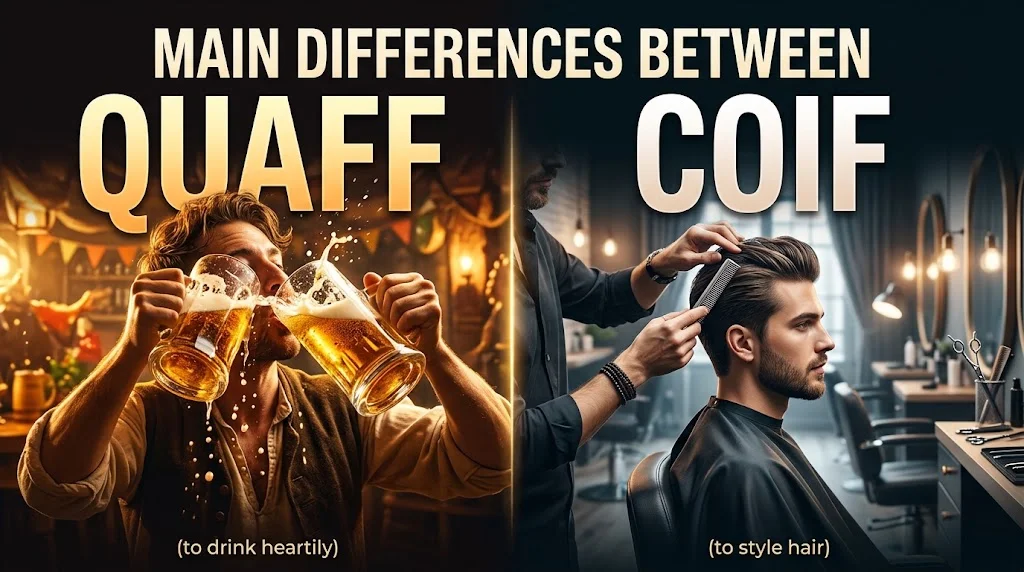
Although the words are visually similar, their meanings are completely different.
| Feature | Quaff | Coif |
| Main meaning | Drink heartily | Style hair or refer to a hairstyle/head covering |
| Common grammatical role | Verb | Verb and noun |
| Related subject | Drinks and drinking | Hair and head coverings |
| Typical context | Literature, storytelling, formal or playful writing | Hair styling, fashion, historical writing |
| Example | They quaffed the cool cider. | The stylist coiffed her hair. |
| Can refer to hair? | No | Yes |
| Can refer to drinking? | Yes | No |
Meaning Difference
The biggest difference is meaning.
Quaff is about drinking.
Coif is about hair or a head covering.
For example:
- The guests quaffed the lemonade. → They drank it heartily.
- The stylist coifed the model’s hair. → The stylist arranged the hair.
Changing one word for the other completely changes the meaning of the sentence.
Function Difference
Quaff generally describes an action involving a drink.
Coif describes an action involving hair when used as a verb, or a hairstyle/head covering when used as a noun.
Context Difference
You might encounter quaff in historical fiction, fantasy writing, humorous prose, or descriptions of celebrations.
You might encounter coif in fashion writing, beauty-related descriptions, historical texts, and literary prose.
Quaff vs Coif: Pronunciation
Pronunciation can contribute to confusion, particularly for English learners.
- Quaff is generally pronounced like “kwaf.”
- Coif is generally pronounced like “koyf.”
The vowel sounds are different, even though the words share some letters.
A useful distinction is:
quaff → kwaf → drink
coif → koyf → hair
Are Quaff and Coif Homophones?
No. Quaff and coif are not homophones because they are not pronounced the same way.
They may look somewhat similar in writing, but their vowel sounds and meanings differ.
This makes them an example of words that can cause spelling confusion rather than true homophone confusion.
Grammar Guide
Understanding the grammatical role of each word makes the difference much easier to remember.
How Each Term Is Used in Sentences
Quaff
Quaff is primarily a verb.
Common forms include:
- Present: quaff
- Third-person singular: quaffs
- Past tense: quaffed
- Present participle: quaffing
Examples:
- They quaff cold water.
- He quaffs his drink quickly.
- She quaffed a cup of tea.
- The travelers were quaffing lemonade.
The word normally takes a drink as its object.
Coif
Coif can be both a verb and a noun.
As a verb:
- The stylist coifed her hair.
As a noun:
- Her coif was carefully arranged.
Verb forms include:
- Present: coif
- Third-person singular: coifs
- Past tense: coifed
- Present participle: coifing
Common Mistakes Learners Make
Mistake 1: Using “coif” for drinking
Incorrect:
- They coifed their wine.
Correct:
- They quaffed their wine.
Mistake 2: Using “quaff” for hair
Incorrect:
- The stylist quaffed her hair.
Correct:
- The stylist coiffed her hair.
Mistake 3: Assuming similar spelling means similar meaning
The words look related, but they are not synonyms.
Mistake 4: Treating “coif” only as a verb
Coif can also be a noun, especially when discussing a hairstyle or historical head covering.
Mistake 5: Using “quaff” in every drinking situation
Although grammatically possible, quaff often has a literary or expressive tone. In ordinary conversation, drink is usually more natural.
Simple Rules to Remember
Use these quick rules:
- Quaff = drink heartily.
- Coif = style hair.
- A quaff is connected with a beverage.
- A coif is connected with hair or a head covering.
- Quaff is mainly a verb.
- Coif can be a verb or noun.
- If the sentence involves a glass, cup, or beverage, consider quaff.
- If the sentence involves hair styling, consider coif.
Quick Tips for Writing and Speaking
When writing, ask yourself what action or object you are describing.
If someone is drinking:
Use quaff.
If someone is styling hair:
Use coif.
For everyday speech, remember that quaff is relatively uncommon and can sound literary or playful. Drink is usually the natural choice in ordinary conversation.
Likewise, coif is less common than everyday phrases such as style the hair or do someone’s hair.
When to Use Each One
When to Use Quaff
Use quaff when you want to describe drinking enthusiastically, deeply, or heartily.
Appropriate contexts include:
- Literary writing
- Historical fiction
- Fantasy stories
- Humorous descriptions
- Formal or expressive prose
- Descriptions of celebrations
- Narratives involving drinking
Example:
After reaching the mountain shelter, the hikers quaffed cool water.
When to Use Coif
Use coif when discussing hair styling or, as a noun, a hairstyle or historical head covering.
Appropriate contexts include:
- Beauty writing
- Fashion descriptions
- Historical writing
- Character descriptions
- Literary prose
- Costume discussions
Example:
The stylist coiffed the actress’s hair for the award ceremony.
When NOT to Use Each One
When Not to Use Quaff
Do not use quaff when you mean to style or arrange hair.
Incorrect:
The barber quaffed the man’s hair.
Correct:
The barber coiffed the man’s hair.
Also, avoid using quaff when you simply want the most natural everyday word for drinking. While quaff is correct in suitable contexts, drink is usually clearer and more conversational.
When Not to Use Coif
Do not use coif when you mean to drink something.
Incorrect:
The guests coifed their coffee.
Correct:
The guests drank their coffee.
Or, in a more expressive style:
The guests quaffed their coffee.
Remember that coif belongs to the semantic field of hair and head coverings, not beverages.
Which One to Use (Decision Guide)
Choosing between these words is easy when you identify the subject of the sentence.
Choose “Quaff” If:
- Someone is drinking.
- The object is a beverage.
- You want an expressive or literary word for drinking.
- The sentence describes enthusiastic or hearty drinking.
Example:
The travelers quaffed fresh water.
Choose “Coif” If:
- Someone is styling hair.
- You are describing an arranged hairstyle.
- You are discussing a historical head covering.
- The sentence relates to hair, fashion, or headwear.
Example:
The stylist coiffed the bride’s hair.
Quick Decision Question
Ask:
“Is this sentence about drinking?”
→ Quaff
“Is this sentence about hair or a head covering?”
→ Coif
Real-World Practical Examples
Quaff Examples
- Education:
The literature class examined a scene in which the characters quaffed wine during a medieval feast.
Here, quaffed describes enthusiastic drinking. - Daily Life:
After the long walk, the family quaffed glasses of cold lemonade.
The word emphasizes hearty drinking. - Science:
The researchers did not simply quaff the experimental beverage; they measured each sample carefully.
Here, quaff contrasts casual drinking with controlled scientific procedures. - Business:
At the company celebration, the employees quaffed sparkling cider after completing the project.
The word describes drinking during a celebration. - Writing:
The novelist described the pirates as they quaffed ale beneath the lanterns.
Quaffed creates a vivid literary atmosphere. - Technology:
After finishing the overnight software update, the developer quaffed a large cup of coffee.
The word is used humorously to emphasize drinking. - Conversation:
We sat outside and quaffed cold drinks while watching the sunset.
The word gives the sentence an expressive tone.
Coif Examples
- Education:
The history students learned how women might have worn a simple coif in medieval Europe.
Here, coif refers to a historical head covering. - Daily Life:
The stylist coifed her hair before the family celebration.
Here, coifed means carefully styled. - Science:
The researcher wore protective equipment rather than relying on a decorative coif in the laboratory.
The word refers to a hair covering or hairstyle-related concept. - Business:
The professional stylist coifed the speaker’s hair before the corporate event.
The verb describes hair styling. - Writing:
The author described the queen’s elaborate coif in great detail.
Here, coif is a noun referring to the hairstyle. - Technology:
The virtual character generator gave the historical character an elaborate coif.
The noun refers to the character’s hairstyle. - Conversation:
I like how the stylist coifed your hair for the ceremony.
The word means styled the hair.
Self-Assessment (Fill in the Blanks)
Complete each sentence with quaff, quaffed, quaffing, coif, coifed, coifing, or coif as appropriate.
- After the marathon, the runners ______ cold water.
- The stylist will ______ the actress’s hair before the performance.
- The medieval woman wore a simple ______ over her head.
- The travelers ______ refreshing drinks after crossing the desert.
- The novelist described the warriors ______ ale around the fire.
- The barber carefully ______ the groom’s hair.
- If the sentence is about drinking heartily, the correct verb is ______.
- If the sentence is about styling someone’s hair, the correct verb is ______.
- The queen’s elaborate ______ attracted attention at the ceremony.
- The sailors ______ their drinks during the celebration.
- The stylist spent an hour ______ the bride’s hair.
- The students read a historical description of a linen ______.
- The characters ______ wine during the fictional feast.
- The hairdresser ______ the actor’s hair for the film.
- The sentence “They ______ lemonade after the hike” requires a word related to drinking.
- The sentence “She ______ her hair before the interview” requires a word related to styling.
- A beverage can be something that people ______.
- A hairstyle can be described as a ______.
- “The guests ______ cider enthusiastically” requires ______ rather than coif.
- “The stylist ______ the model’s hair” requires ______ rather than quaff.
Answers
- quaffed — The runners drank the water heartily after the marathon.
- coif — Coif means to style or arrange hair.
- coif — Here, coif is a noun referring to a head covering.
- quaffed — The travelers drank the beverages heartily.
- quaffing — The characters were drinking ale enthusiastically.
- coifed — The barber styled the groom’s hair.
- quaff — Quaff means to drink heartily or deeply.
- coif — Coif, as a verb, means to style or arrange hair.
- coif — Here, coif functions as a noun referring to a hairstyle.
- quaffed — The sailors drank their beverages heartily.
- coifing — Coifing is the present participle of coif.
- coif — The word can refer to a close-fitting historical head covering.
- quaffed — The characters drank the wine heartily.
- coifed — The actor’s hair was styled.
- quaff — The sentence concerns drinking.
- coifed — The sentence concerns styling hair.
- quaff — A person can quaff a beverage.
- coif — Coif can be used as a noun for a hairstyle.
- quaffed — The guests were drinking cider enthusiastically.
- coifed — The stylist arranged the model’s hair.
Conclusion:
Understanding quaff or coif becomes much easier once you connect each word with its meaning and context. Quaff relates to drinking, especially drinking heartily or enthusiastically, while coif relates to hair styling and can also refer to a hairstyle or a historical head covering. Although these words look somewhat similar, they are not interchangeable, and using the wrong one can completely change the meaning of a sentence.
For everyday English, you will usually hear “drink” or “style the hair,” but quaff and coif can add a more descriptive, literary, or historical touch to your writing. The easiest memory trick is simple: quaff means drink, while coif means style or cover the hair. By remembering this basic distinction, you can confidently choose the correct word in conversations, creative writing, academic work, and other contexts.
FAQs
What is the difference between quaff and coif?
Quaff means to drink something heartily or enthusiastically, while coif relates to hair. As a verb, coif means to style or arrange hair. As a noun, it can refer to a hairstyle or a historical close-fitting head covering. The two words have different meanings, grammatical functions, and contexts despite their similar spelling.
Is quaff a verb or a noun?
Quaff is primarily used as a verb meaning to drink deeply or heartily. For example, “The travelers quaffed cold water after the hike.” It describes an action involving a beverage. Although related forms can appear in other grammatical roles, learners will most commonly encounter quaff as a verb in literary, historical, or expressive writing.
Is coif a verb or a noun?
Coif can function as both a verb and a noun. As a verb, it means to style or arrange someone’s hair, as in “The stylist coiffed her hair.” As a noun, it can refer to a hairstyle or a historical close-fitting head covering. Its exact meaning depends on the sentence and surrounding context.
Does quaff mean to drink?
Yes. Quaff means to drink, particularly in a hearty, deep, or enthusiastic manner. It is more expressive than the ordinary verb “drink” and often appears in literary, historical, humorous, or descriptive writing. For example, “The guests quaffed the sparkling cider” suggests that they drank it enthusiastically rather than merely taking a small sip.
Does coif mean hairstyle?
Yes. Coif can refer to a hairstyle when used as a noun. It can also describe the act of styling hair when used as a verb. For example, “Her elegant coif complemented her dress” uses coif as a noun, while “The stylist coifed her hair” uses it as a verb.
Are quaff and coif pronounced the same?
No. Quaff and coif are pronounced differently. Quaff is generally pronounced like “kwaf,” while coif is pronounced like “koyf.” Their similar spelling can make them easy to confuse, but their pronunciation and meanings are distinct. Remembering the sound difference can help English learners recognize and use each word correctly.
Can I use quaff for hair?
No. Quaff should not be used to describe styling or arranging hair. The correct word is coif. For example, “The stylist coifed her hair” means the stylist carefully arranged her hair. Using quaff in this context would be incorrect because quaff is associated with drinking rather than hair or hairstyles.
Can I use coif for drinking?
No. Coif does not mean to drink. When describing someone drinking heartily or enthusiastically, quaff is the appropriate word. For example, “The travelers quaffed cool lemonade” correctly describes enthusiastic drinking. If you simply mean ordinary drinking, the more common everyday verb drink is usually the best choice.
Why are quaff and coif easy to confuse?
The words quaff and coif are easy to confuse because they have similar-looking spellings and both are relatively uncommon in everyday English. However, they describe completely different ideas. Quaff concerns drinking, while coif concerns hair or a head covering. Learning their meanings through simple example sentences makes the distinction much easier.
Which word should I use: quaff or coif?
Choose quaff when your sentence involves drinking a beverage heartily or enthusiastically. Choose coif when your sentence involves styling hair, describing a hairstyle, or referring to a historical head covering. A simple memory rule is quaff equals drink and coif equals hair. This distinction will help you avoid confusion in both writing and conversation.


