
Angry similes are creative comparisons that help readers clearly imagine feelings of anger, frustration, rage, or irritation. Unlike ordinary descriptions, they compare anger to familiar people, animals, objects, emotional, or powerful forces.
Learning how to use similes correctly can make your writing more vivid, emotional, and memorable while keeping your language natural and easy to understand.
Comparison Overview
Angry similes are not different words that compete for grammatical correctness. Instead, they are figurative expressions that describe anger by comparing it with something else, usually by using “like” or “as.”
For example:
- “He was as angry as a raging bull.”
- “She looked like a volcano ready to erupt.”
- “His voice was as sharp as a thunderclap.”
- “I was like a kettle about to boil over.”
These expressions allow writers and speakers to show the intensity, appearance, sound, or behavior of anger rather than simply saying, “He was angry.”
Similes can be gentle, humorous, dramatic, frightening, or poetic depending on the context.
Definition of Angry Similes
An angry simile is a figurative comparison that describes anger by comparing an angry person, emotion, action, voice, or reaction to another familiar thing.
A simile generally uses words such as:
- like
- as
- as…as
For example, “She was angry” tells the reader about an emotion directly. However, “She was as angry as a stormy sea” creates a stronger mental image.
The main purpose of an angry simile is to make anger easier to visualize and emotionally understand.
Angry similes can compare anger to:
- Animals: “He was as angry as a wild bull.”
- Weather: “Her anger was like a violent storm.”
- Fire: “He was like a fire about to spread.”
- Objects: “She was as tense as a spring ready to snap.”
- Nature: “His temper was like an erupting volcano.”
- Sounds: “Her voice was like cracking thunder.”
Main Differences Between Different Types of Angry Similes
Although angry similes share the same basic purpose, they can differ considerably in intensity, imagery, tone, and context.
| Type of Angry Simile | Main Focus | Example | Typical Effect |
| Animal-based | Behavior or aggression | “He was as angry as a cornered bear.” | Powerful |
| Fire-based | Intensity | “Her anger burned like a wildfire.” | Dramatic |
| Weather-based | Emotional force | “His rage was like a violent storm.” | Intense |
| Nature-based | Sudden power | “She was like a volcano about to erupt.” | Dramatic |
| Object-based | Tension | “He was like a kettle ready to boil over.” | Humorous |
| Sound-based | Voice or expression | “Her voice was like thunder.” | Strong |
| Humorous | Exaggerated anger | “He looked like a cat that had just been soaked.” | Lighthearted |
| Poetic | Emotional atmosphere | “His anger moved like dark clouds.” | Literary |
The most appropriate simile depends on the kind of anger you want to communicate.
Types of Angry Similes
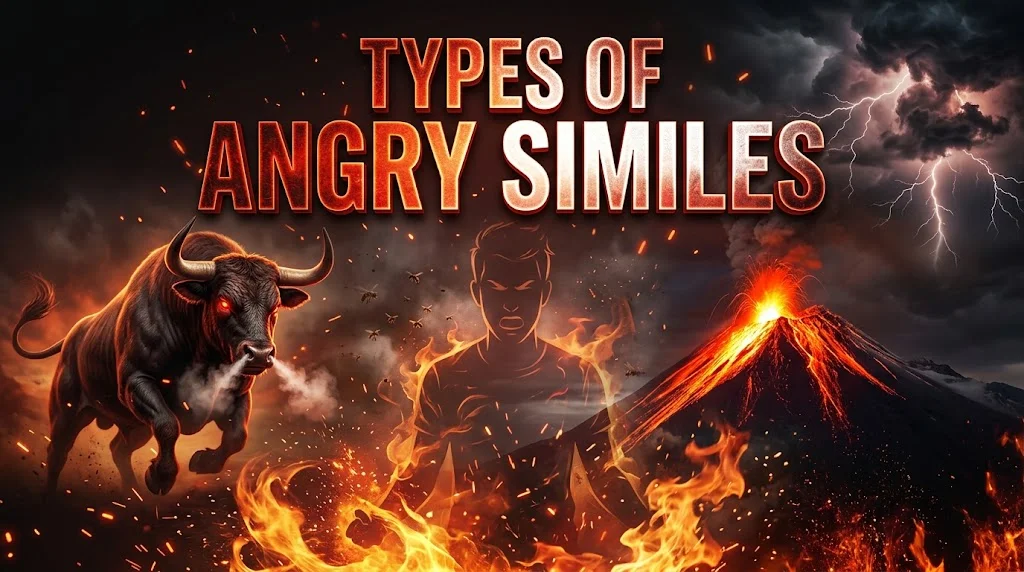
Animal-Based Similes
Animal comparisons are useful when you want to emphasize aggression, defensiveness, or threatening behavior.
Examples:
- “He was as angry as a cornered bear.”
- “She was like a lion defending its territory.”
- “He looked as fierce as a wolf in the wild.”
- “The coach was as angry as a bull.”
- “She snapped like an irritated dog.”
Fire-Based Angry Similes
Fire is one of the strongest images for anger because it suggests heat, danger, growth, and loss of control.
Examples:
- “His anger burned like a wildfire.”
- “She was as hot with anger as a blazing furnace.”
- “His temper flared like a match.”
- “Her frustration spread like fire through dry grass.”
- “He was like a flame that could not be extinguished.”
Weather-Based Similes
Storms can represent powerful, unpredictable, and overwhelming anger.
Examples:
- “His anger was like a thunderstorm.”
- “She was as fierce as a hurricane.”
- “His voice crashed like thunder.”
- “Her mood darkened like a storm cloud.”
- “His rage rolled through the room like thunder.”
Volcano-Based Similes
Volcano imagery works particularly well for anger that has been building for a long time.
Examples:
- “He was like a volcano ready to erupt.”
- “Her frustration was building like pressure inside a volcano.”
- “His anger exploded like an erupting volcano.”
- “She looked like a mountain about to burst.”
- “His temper was as unpredictable as a volcano.”
Object-Based Angry Similes
Objects can create relatable or humorous comparisons.
Examples:
- “He was like a kettle ready to boil over.”
- “She was as tense as a stretched rubber band.”
- “His temper was like a pressure cooker.”
- “He was like a tightly wound spring.”
- “She looked like a shaken bottle about to burst.”
Grammar Guide
Similes are usually complete grammatical expressions rather than individual vocabulary items. Their grammar depends on the sentence pattern being used.
Common structures include:
Subject + be + like + noun
He was like a volcano.
Subject + be + as + adjective + as + noun
She was as angry as a raging bull.
Subject + verb + like + noun
He shouted like thunder.
Noun + be + like + noun
Her anger was like a wildfire.
The simile itself does not change the grammatical category of the main word in the sentence. For example, anger is a noun, while angry is an adjective.
How Each Term Is Used in Sentences
Use angry when describing a person or thing experiencing or showing anger.
- “The customer became angry.”
- “She looked angry.”
- “He was extremely angry.”
Use an angry simile when you want to make the description more vivid.
- “The customer was as angry as a storm.”
- “She looked like a volcano ready to erupt.”
- “He was as angry as a bull.”
A simple pattern to remember is:
Direct description: He was angry.
Simile: He was as angry as a raging bull.
The second sentence creates a stronger image.
Common Mistakes Learners Make
1. Forgetting the comparison word
Incorrect:
“He was angry a bull.”
Better:
“He was angry like a bull.”
Or:
“He was as angry as a bull.”
2. Mixing “like” and “as” incorrectly
Incorrect:
“She was as angry like a volcano.”
Correct:
“She was as angry as a volcano.”
Or:
“She was angry like a volcano.”
3. Using an illogical comparison
A simile should create a recognizable connection.
Weak:
“He was as angry as a pencil.”
Better:
“He was as angry as a raging bull.”
4. Overusing similes
Using an angry simile in every sentence can make writing feel repetitive.
5. Confusing similes with metaphors
A simile usually makes the comparison explicit with like or as.
“He was like a volcano.” — simile
“He was a volcano.” — metaphor
Simple Rules to Remember
- Use like when directly comparing one thing to another.
- Use as…as for adjective-based comparisons.
- Make sure the comparison makes sense.
- Choose an image that matches the intensity of the anger.
- Use gentle images for mild irritation.
- Use powerful images for rage or fury.
- Avoid unnecessary repetition.
- Keep the surrounding sentence grammatically correct.
Quick Tips for Writing and Speaking
When creating an angry simile, first decide how intense the emotion is.
For mild irritation:
“He was like a buzzing fly that would not settle down.”
For moderate anger:
“She was as tense as a spring ready to snap.”
For intense anger:
“His rage was like a wildfire.”
For extreme anger:
“He was like a volcano bursting through the ground.”
Also consider your audience. A humorous simile may work well in casual writing, while a dramatic or poetic comparison may be better for fiction.
When to Use Each One
Use angry similes when you want to:
- Make descriptions more vivid.
- Show emotional intensity.
- Improve creative writing.
- Make stories more engaging.
- Help children understand emotions.
- Add personality to dialogue.
- Create memorable descriptions.
- Make speeches more expressive.
- Describe characters in fiction.
- Explain emotional reactions without repeating “angry.”
For academic or professional writing, use them carefully. Figurative language can make an explanation memorable, but excessive use may reduce clarity.
When NOT to Use Each One
Avoid angry similes when:
- The situation requires extremely precise language.
- A legal or technical document needs literal wording.
- The comparison could confuse the reader.
- The simile sounds unnatural.
- You are describing a sensitive event where exaggeration would be inappropriate.
- Several similes appear repeatedly in a short paragraph.
- The comparison changes the intended meaning.
For example, saying:
“The scientist was as angry as a volcano.”
may sound dramatic but is unnecessary in a technical report. A simple sentence such as “The scientist strongly objected to the decision” may be more appropriate.
Which One to Use (Decision Guide)
Choose your angry simile according to the feeling you want to communicate.
If the anger is aggressive: use an animal comparison.
“He was as angry as a cornered bear.”
If the anger is powerful: use fire.
“Her anger burned like a wildfire.”
If the anger is overwhelming: use a storm.
“His rage was like a violent storm.”
If the anger has been building: use a volcano.
“She was like a volcano ready to erupt.”
If the anger is humorous: use an everyday object.
“He was like a kettle about to boil over.”
If the anger is tense rather than explosive: use a spring.
“She was as tense as a stretched spring.”
The best choice is the one that matches both the emotion and the context.
Real-World Practical Examples
Angry Similes in Education
- “The student was as angry as a storm cloud after receiving an unfair grade.”
This shows strong frustration in a school setting. - “The teacher looked like a volcano when the students continued talking.”
The comparison emphasizes rising anger. - “He was as tense as a stretched rubber band before the difficult exam.”
This can describe emotional pressure and frustration. - “The coach was like thunder after the team ignored the instructions.”
The simile emphasizes a powerful reaction. - “She became as fierce as a lion when another student insulted her friend.”
The comparison shows defensive anger.
Self-Assessment (Fill in the Blanks)
Complete each sentence with a suitable word or phrase related to angry similes.
- He was as angry ______ a raging bull.
- She looked ______ a volcano ready to erupt.
- His anger burned like a ______.
- Her voice was like ______ during the argument.
- The manager was as tense as a stretched ______.
- His temper was like a pressure ______.
- She became angry ______ a storm after hearing the news.
- He was like a ______ ready to boil over.
- Her frustration spread like ______ through dry grass.
- His rage rolled through the room like ______.
- A simile commonly uses words such as “like” and ______.
- “He was like a volcano” is an example of a ______.
- “He was a volcano” is a ______ rather than a simile.
- Use a fire comparison when you want to emphasize the ______ of anger.
- Use a volcano comparison when anger has been ______ for some time.
- Use an animal comparison when you want to emphasize ______ or aggression.
- “She was as angry ______ a lion” uses the correct “as…as” pattern.
- An angry simile should create a clear and understandable ______.
- In formal technical writing, angry similes should generally be used ______.
- The best angry simile is the one that matches the emotion and ______.
Answers
- as — The standard pattern is “as angry as.”
- like — “Looked like” introduces a direct comparison.
- wildfire — Fire imagery communicates intense anger.
- thunder — Thunder creates a strong image for an angry voice.
- spring — A stretched spring suggests tension.
- cooker — A pressure cooker suggests anger building toward release.
- like — “Angry like a storm” creates a direct comparison.
- kettle — A boiling kettle is a familiar image for rising frustration.
- fire — Fire can symbolize anger spreading quickly.
- thunder — Thunder represents a powerful and overwhelming sound.
- as — “Like” and “as” are common markers of similes.
- simile — “Like a volcano” explicitly compares two things.
- metaphor — The comparison is made directly without “like” or “as.”
- intensity — Fire is effective for showing powerful anger.
- building — A volcano is a useful image for anger that gradually increases.
- power — Animal comparisons often emphasize aggressive or defensive behavior.
- as — The correct structure is “as angry as a lion.”
- comparison — A good simile connects two recognizable things.
- sparingly — Technical writing usually benefits from precise, literal language.
- context — The comparison should fit the situation and intended tone.
Conclusion:
Angry similes are a simple yet powerful way to make descriptions of anger more vivid, emotional, and memorable. Instead of simply saying that someone is angry, an angry simile helps readers picture the feeling by comparing it with something familiar, such as a raging bull, blazing fire, violent storm, or erupting volcano. The right comparison can show whether the anger is mild, intense, sudden, controlled, or close to exploding.
When writing similes, always choose an image that naturally fits the emotion and situation. Using like and as…as correctly also helps keep your sentences grammatically clear. Whether you are writing a story, school assignment, speech, conversation, or creative description, similes can add personality and emotional depth. With thoughtful comparisons and natural wording, you can turn ordinary descriptions into engaging expressions that readers easily understand and remember.
FAQs
What is an angry simile?
An angry simile is a figurative comparison used to describe anger in a vivid way. It commonly uses words such as “like” or “as” to compare anger with something familiar. For example, “He was as angry as a raging bull” helps readers imagine the intensity and behavior associated with the person’s anger.
What is an example of an angry simile?
A common example is, “She was like a volcano ready to erupt.” This comparison suggests that the person has strong anger that may soon become uncontrollable. Other examples include “He was as angry as a raging bull” and “Her anger burned like a wildfire,” depending on the intensity and context.
Why are similes used in writing?
Similes make emotional descriptions more vivid and engaging. Instead of simply telling readers that someone is angry, a simile creates a mental picture of the emotion. This technique can make characters, stories, speeches, and creative writing more expressive while helping readers understand the strength and nature of the anger.
What words are commonly used in angry similes?
The words like and as are commonly used to form angry similes. For example, “His anger was like a storm” uses “like,” while “She was as angry as a lion” uses the “as…as” structure. Other useful imagery includes fire, storms, animals, volcanoes, thunder, pressure, and boiling objects.
Can similes be positive?
Similes usually describe a negative or intense emotion, but they can sometimes communicate positive qualities connected with anger, such as courage, determination, or standing up for someone. For example, “She fought like a lion to defend her friend” suggests strength and determination rather than uncontrolled anger.
What is the difference between an angry simile and an angry metaphor?
An angry simile makes a comparison using words such as “like” or “as,” while a metaphor makes the comparison directly. For example, “He was like a volcano” is a simile, whereas “He was a volcano” is a metaphor. Both can describe anger, but they create the comparison in different grammatical ways.
How can I create my own similes?
Start by deciding how the anger feels or behaves. Then choose something that has a similar quality. For intense anger, you might compare it with fire or a storm. For building frustration, consider a pressure cooker or volcano. Finally, connect the ideas naturally with “like” or “as…as.”
Are similes suitable for children?
Yes, similes can be very suitable for children when the comparisons are simple and age-appropriate. Expressions such as “He was as angry as a roaring lion” or “She was like a storm cloud” help young readers understand emotions through familiar images while making stories more colorful and interesting.
Can I use similes in academic writing?
Similes can be used in some academic writing, particularly in literary analysis or discussions about language and emotion. However, technical and highly formal writing usually benefits from precise, literal wording. Before using a simile, consider whether it improves clarity or simply adds unnecessary decoration to the explanation.
What makes a good angry simile?
A good angry simile creates a clear comparison, matches the intensity of the emotion, and fits the context. It should help readers imagine the anger without sounding forced or confusing. Strong examples often compare anger with familiar forces such as storms, fire, animals, pressure, thunder, or volcanic eruptions.


